









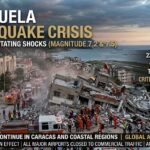




























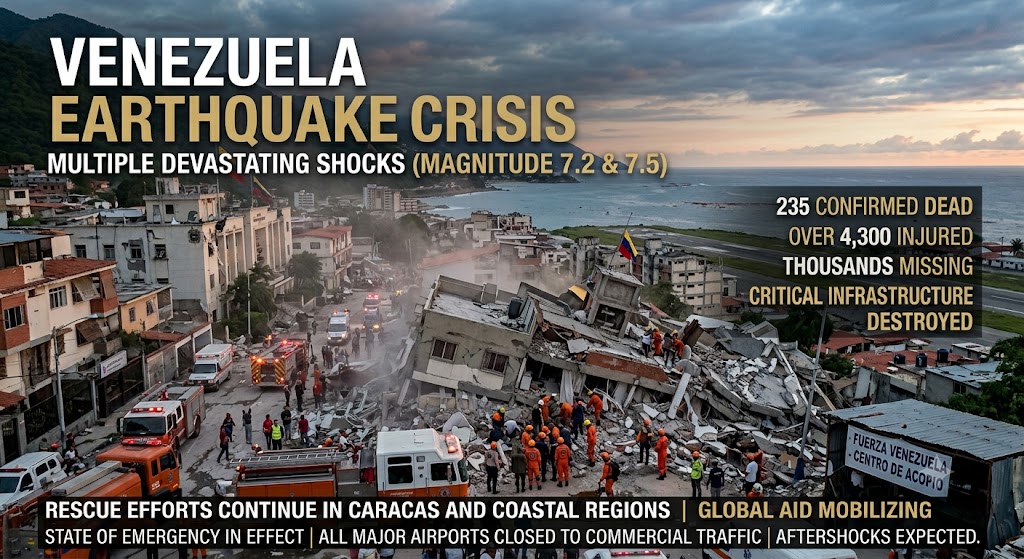

CARACAS, VENEZUELA — Rescuers are racing against time along Venezuela’s northern coast after a rare and catastrophic “doublet” earthquake struck the region. Two massive tremors—measuring magnitudes 7.2 and 7.5—hit just 39 seconds apart on Wednesday evening, trapping hundreds beneath collapsed concrete and triggering a sweeping humanitarian emergency.
As of Friday morning, officials have confirmed 235 deaths and more than 4,300 injuries, numbers that are expected to rise significantly as rescue teams finally reach isolated coastal pockets. Thousands remain missing.
The “Double Tap” Event
The disaster has been described by seismologists as a doublet earthquake, a rare occurrence where two large tectonic events happen in immediate succession.
- The Mechanism: The double punch occurred at a shallow depth of 10 kilometers along the highly active plate boundary where the Caribbean and South American tectonic plates meet horizontally (strike-slip faulting).
- The Scale: The magnitude 7.5 mainshock stands as the most powerful earthquake to hit Venezuela since 1900. The violent vibrations tore down power lines and compromised cellular networks across north-central Venezuela, including Caracas, Aragua, and Carabobo.
Ground Zero: La Guaira Devastated
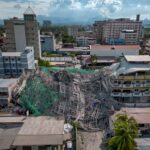
While intense shaking sent panicked residents running into the streets of the capital city of Caracas, the coastal region of La Guaira, just north of the capital, bore the brunt of the destruction.
Acting President Delcy Rodríguez has declared La Guaira a disaster zone. Around 250 buildings across the affected states have completely or partially collapsed. Compounding the crisis, the Simón Bolívar International Airport in Maiquetía has sustained severe structural damage and remains closed to commercial traffic, complicating the arrival of airborne foreign relief.
“The world was moving for an eternity,” recalled one Caracas resident. “You survived the first shock, and before you could even catch your breath, the entire ground buckled again even harder.”
Emergency Mobilization and Global Response
A nationwide state of emergency is in place. School classrooms have been shuttered indefinitely, with many being converted into makeshift temporary shelters and donation centers.
The emergency has triggered an urgent international response despite existing geopolitical friction:
- The United Nations: UNOCHA is coordinating the rapid deployment of international urban search-and-rescue teams, while the World Food Programme (WFP) and UNHCR have mobilized immediate food and shelter assets.
- Economic Relief: In a rare move, the U.S. Treasury issued a special license explicitly authorizing financial transactions related to earthquake relief efforts that would otherwise be blocked by standing economic sanctions.
- Infrastructure Support: Private sector satellite firms, including Starlink, have announced a month of free internet service for users in Venezuela to assist in restoring critical emergency coordination lines.
Local civil protection forces, the Venezuelan Red Cross, and regional neighbors like Colombia are setting up emergency medical tents. However, with intermittent electricity, ruptured water lines, and a 99% chance of continuous aftershocks exceeding magnitude 4 over the coming week, the window for pulling survivors from the rubble is rapidly closing
