

















































It turns out the digital age still runs on a massive amount of ink and paper! A viral cost disclosure report has revealed an unexpectedly old-school reality about modern banking: the State Bank of India (SBI) shelled out a staggering ₹986.4 crore purely on printing and stationery in the last fiscal year. While that mind-boggling amount accounts for about 1.22% of the banking behemoth’s massive net profit, it is still enough money to fund an entire corporate empire made of paper.
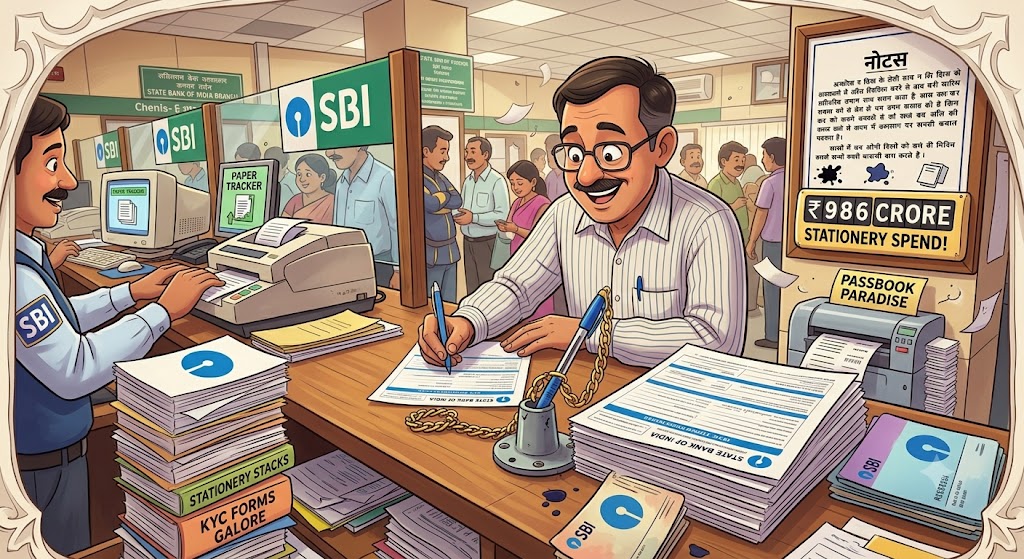
The hilarious revelation has finally solved one of the greatest mysteries of middle-class India. For decades, customers have walked into local branches wondering why that solitary blue ballpoint pen is aggressively chained, tied, and taped to the wooden desk like a priceless artifact. Now we finally know the truth—with a near ₹1,000 crore stationery bill on the line, management isn’t taking any chances with people accidentally slipping a pen into their pockets! Between printing endless passbooks, physical KYC forms, and keeping the desk pens securely locked down, SBI is clearly making sure every single paisa is accounted for.
The Paper Empire: Breaking Down the Numbers
To put this ₹986.4 crore expense into perspective, it helps to look at the sheer scale of SBI’s operations. As India’s largest public sector bank, SBI serves over 50 crore (500 million) customers across more than 22,500 branches. When you break it down, that massive stationery bill actually translates to roughly ₹20 per customer annually.
While the internet had a field day joking about the chained pens, the reality of running a banking giant in India requires an immense amount of physical documentation:
- Passbook Culture: Despite the rise of the YONO app and digital banking, a vast portion of India’s population—especially in rural and semi-urban areas—relies heavily on physical passbooks for financial record-keeping and official identity verification.
- Regulatory Compliance: Physical KYC (Know Your Customer) forms, loan documentation, account opening kits, and mandatory physical audit trails contribute significantly to the paper trail.
- The “Chained Pen” Mystery Solved: With millions of footfalls daily, loose stationery would vanish within hours. That aggressively taped blue ballpoint pen isn’t just a meme; it’s a micro-level cost-control measure operating at an macro-scale.
Despite the heavy printing bill, the expense represents just a tiny fraction (1.22%) of SBI’s historic annual net profit of ₹81,034 crore, proving that the bank’s massive scale allows it to absorb these traditional operational costs comfortably while it continues its massive digital transition.
