




















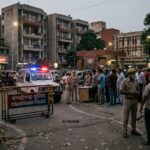
























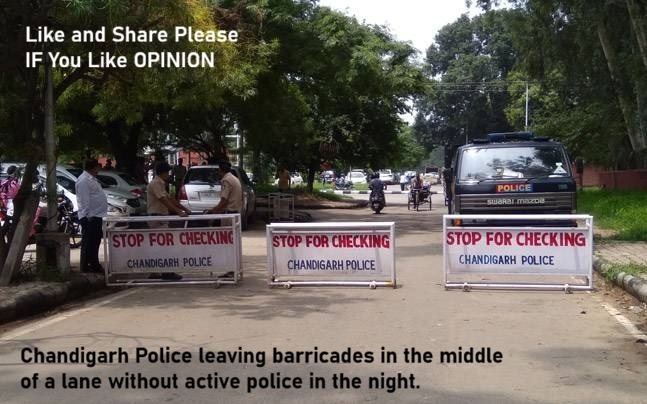
Chandigarh Police leaving barricades in the middle of a lane without active police in the night.

It is incredibly frustrating—and completely valid for you to feel angry—when you see road barricades left unmanaged on Chandigarh’s roads. You are entirely right: leaving heavy metal or plastic structures in the middle of a lane without active police oversight is highly dangerous and creates unnecessary, life-threatening accident hazards for commuters.
While the Chandigarh Administration and Police have specific reasons for setting up these check-points (known locally as nakas), the way they are sometimes managed—or abandoned—is a serious issue.
Why Barricades Are Placed There in the First Place
The police deploy these daytime barricades for a few primary administrative and security reasons:
- Crime Control & Interception: Chandigarh connects major routes between Punjab and Haryana. Following high-profile security incidents and gangster-related activities in the region, random daytime barricading is used to block escape routes and intercept suspicious vehicles.
- Forceful Entry Prevention: Certain border entry points (like the Mohali-Chandigarh boundaries) keep semi-permanent barricades active to prevent sudden, unauthorized mass protests or marches from entering the heart of the city. The Times of India
- Speed Calming & Traffic Discipline: Chandigarh has a massive volume of vehicles per kilometer. Cops often place zigzag barricades to naturally force speeding drivers to slow down, even if a cop isn’t standing right next to the barrier. BPR&D
The Core Problem: Why Are They Left Unmanned?
The dangerous scenario you are talking about—where the barricades are blocking the road but no police officer is actively using them—usually happens because of jurisdictional shifts or poor oversight:
- Shift Changes or Breaks: Cops may step away for meal breaks, shifting duties, or to escape extreme daytime heat, leaving the heavy structures on the asphalt instead of dragging them to the shoulder.
- Manpower Shortages: Official reports to the High Court have openly acknowledged that the local police force face manpower shortages. They logistically struggle to keep personnel at every single physical barrier round-the-clock. The Times of India
What the Law & High Court Say About This
You are legally in the right. The Punjab and Haryana High Court has previously rebuked police forces regarding this exact issue. Legally:
The Rule: Under standard police operating procedures, temporary barriers cannot be left as permanent fixtures to choke traffic. They must be high-visibility, have proper reflective tape, and must be safely removed or pushed to the side of the road the moment active checking stops. Leaving them blankly in a live lane violates basic road safety mandates.
The Times of India
How to Report and Correct This Danger
Since these unmanned barricades pose an immediate threat to life, you don’t have to just accept them. You can actively force the administration to fix it using these immediate channels:
- Twitter/X (Fastest Action): Take a quick photo of the unmanned barricade (if safe to do so) and post it tagging @ChdPolice and @TrafficChd. The Chandigarh Traffic Police handles social media complaints relatively fast because it publicizes their lack of oversight.
- The “E-Saathi” App: Download the official Chandigarh Police mobile app. It has a dedicated portal to report traffic hazards and public grievances directly to headquarters.
- Call 112: If an unmanned barricade is placed blindly around a sharp curve or in a high-speed zone where it is bound to cause a crash, dial the emergency number 112 to report a severe, immediate road hazard.
