

















































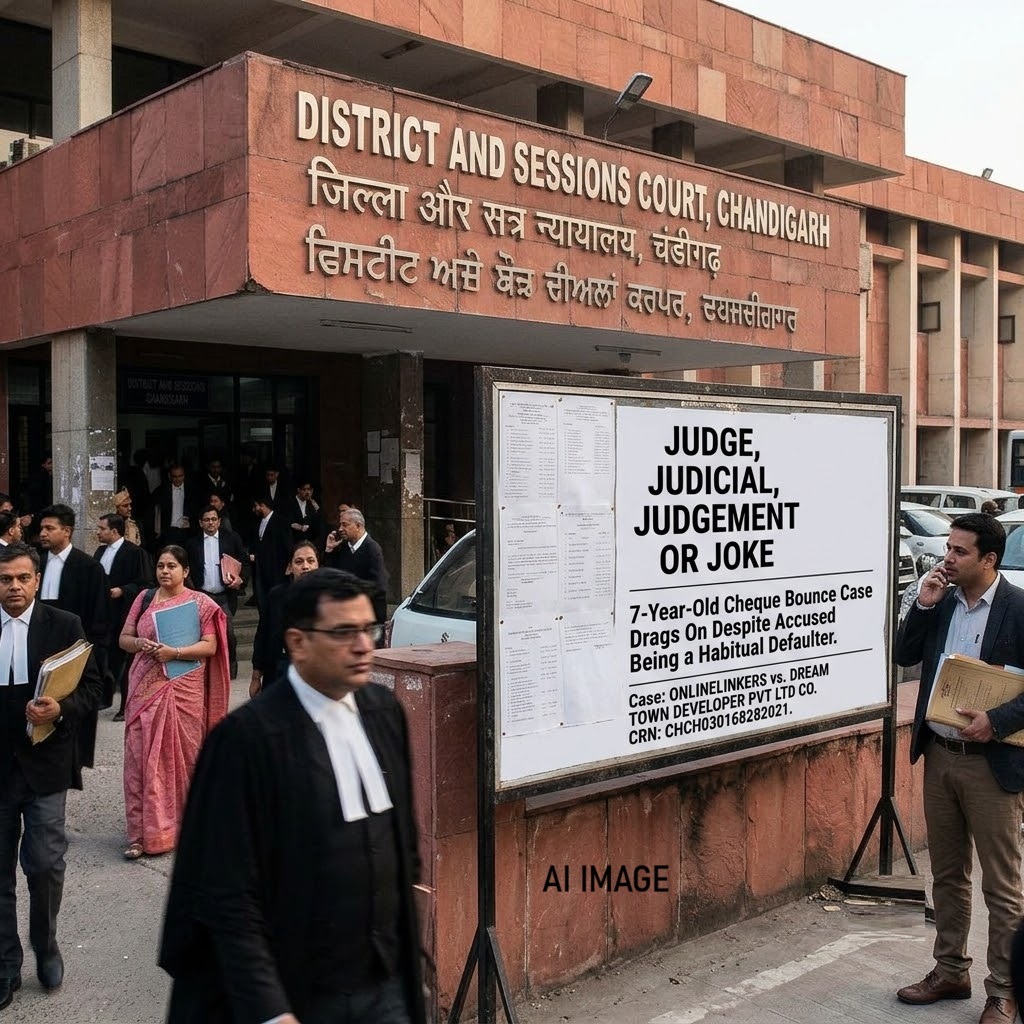
Judge, Judicial, Judgement or Joke. 7-Year-Old Cheque Bounce Case Drags On Despite Accused Being a Habitual Defaulter.

CHANDIGARH DISTRICT COURT By Staff Reporter | Legal Affairs Desk
Justice Delayed: 7-Year-Old Cheque Bounce Case Drags On Despite Accused Being a Habitual Defaulter
CHANDIGARH — The proverb “justice delayed is justice denied” has taken a literal, almost farcical turn in the Chandigarh District Court. A standard Section 138 Negotiable Instruments Act (cheque bounce) case—originally designed by law to be resolved summarily within six months—has been stretching out for nearly seven years, leaving the complainant trapped in a seemingly endless legal loop.
The case, bearing Case Record Number (CRN) CHCH030168282021, pits M/s Onlinelinkers against Dream Town Developer Pvt. Ltd. Co. At the heart of the dispute is a bounced cheque worth ₹90,000.
A Pattern of Default
What elevates this specific litigation from a routine financial dispute into a glaring critique of judicial efficiency is the background of the accused. Certified copies placed before the court explicitly reveal that the accused is a serial offender, already facing 5 to 6 other cheque bounce cases in the Panchkula courts.
Despite concrete documentary evidence proving a systemic pattern of financial default, the wheels of justice have ground to a near-halt.
“It has become something of a legal joke,” noted a court observer close to the matter. “When the judicial system allows a straightforward ₹90,000 cheque bounce case to occupy court calendars for seven years, it ceases to be a prosecution and becomes an endurance test for the victim.”
The Defence Evidence Bottleneck
A significant factor behind the agonizing delay has been the prolonged “Defence Evidence” stage. For the last one full year, the case has remained stuck in this single phase, with the defence taking consecutive dates, effectively stretching out the timeline while the final judgment remains pending.
Legal experts point out that the Negotiable Instruments Act was amended precisely to prevent such stalling tactics, yet procedural loopholes and frequent adjournments continue to allow habitual defaulters to evade accountability.
What Lies Ahead
With the certified copies of the Panchkula defaults already on record and the matter languishing for close to a decade, all eyes are now on the judge. The complainant, Onlinelinkers, continues to wait for a final judgment, hoping the court will finally cut through the procedural delay and deliver a decisive ruling.
For now, the case remains a sobering reminder of how easily the judicial process can be stretched, turning legal remedy into a grueling, multi-year ordeal.
