









































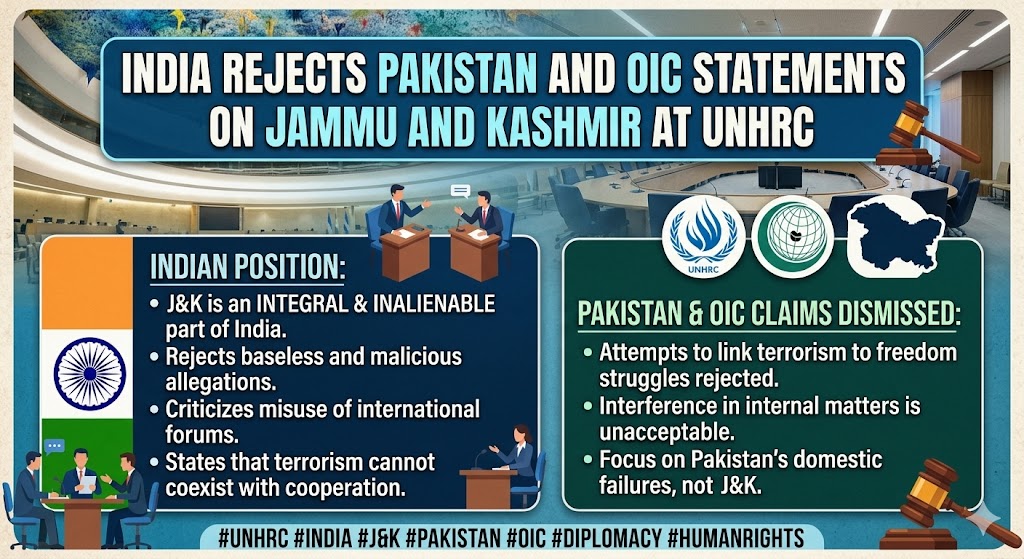
India Rejects Pakistan and OIC Statements on Jammu and Kashmir at UNHRC

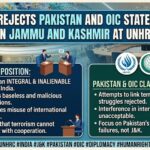
During the 62nd session of the United Nations Human Rights Council (UNHRC), India firmly dismissed what it labeled as “baseless and malicious allegations” from Pakistan. Furthermore, New Delhi rejected references made to Jammu and Kashmir by the Organisation of Islamic Cooperation (OIC), reiterating that the entire region remains an inseparable part of India.
Anupama Singh, the First Secretary at India’s Permanent Mission to the UN, stated that Pakistan frequently exploits international platforms to disseminate propaganda, aiming to deflect attention from its internal crises and state-sponsored terrorism. She emphasized that India had no intention of legitimizing such deceptive tactics, which are amplified through Pakistan’s misuse of its role as the OIC coordinator.
Terror and Human Rights Violations in Pakistan-Occupied Kashmir
Addressing the situation across the Line of Control, Singh asserted that Jammu and Kashmir is historically and permanently an integral part of India. She noted that the sole unresolved matter regarding the territory is the return of Indian lands currently under Pakistan’s illegal occupation.
The Indian diplomat highlighted the growing public unrest in Pakistan-occupied Kashmir (PoK), describing it as the inevitable fallout of decades of military dominance, demographic alteration, and severe crackdowns on basic freedoms. Citing recent violent crackdowns and civilian casualties in areas like Rawalakot, Singh pointed out that under a system sustained entirely by force, citizens are met with state brutality even when demanding basic necessities like food, electricity, and dignity.
Criticism of Pakistan’s Terror Policy
Singh sharply criticized Pakistan’s duality of portraying itself as a victim of terrorism while using it as an instrument of state policy. She remarked that it is paradoxical for a nation to claim victimhood when its own sitting Defence Minister has openly spoken about sheltering, training, and deploying terrorists. She characterized the country as a “Frankenstein state” currently suffering the consequences of the very forces it created.
Call for Revision of the “Outdated” Indus Waters Treaty
Turning to bilateral resource sharing, India signaled a firm stance on the 1960 Indus Waters Treaty, calling it outdated and unaligned with modern realities. Singh argued that it is completely illogical for a state that actively exports cross-border terrorism to expect the continued privileges of a pact rooted in mutual goodwill and cooperation.
She concluded that a technical agreement framed over six decades ago cannot serve as a permanent entitlement, emphasizing that no treaty can remain completely insulated from accountability or frozen in time while geopolitical realities undergo profound changes.
