
















































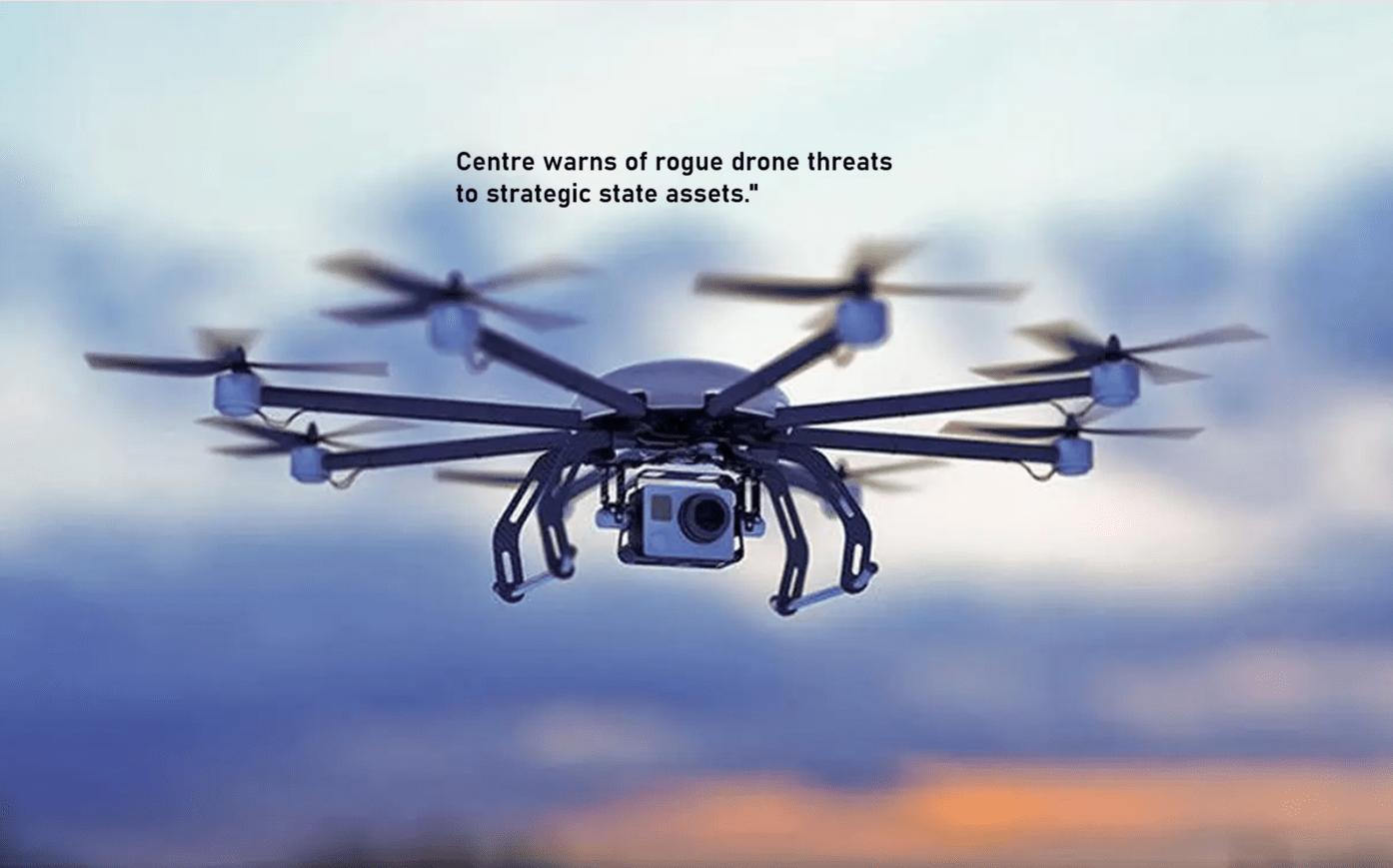

NEW DELHI: In a major national security development, the Union Government has issued a high-priority warning alerting security agencies to potential rogue drone attacks targeting Vital Assets and Vital Installations (VAVIs) across India’s strategic land and maritime borders.
The security advisory, issued by the Marine Security Wing of the Ministry of Ports, Shipping and Waterways, flags an escalating asymmetric threat. Drawing urgent parallels to modern geopolitical conflicts—where low-cost, remote-controlled unmanned aerial vehicles (UAVs) have successfully disrupted multi-billion-dollar infrastructure—the Centre has directed immediate implementation of counter-drone defense mechanisms.
“There is an urgent need to take concrete steps to safeguard our assets, especially those located near the borders, from rogue drones by installing Anti-Drone Systems,” the official communication stated.
Multi-Agency Mobilization Underway
In response to the directive, a coordinated defensive strategy is being deployed across multiple security tiers:
- BSF on the Western Front: The Ministry of Home Affairs (MHA) has empowered the Anti-Rogue Drone Technology Committee within the Border Security Force (BSF). Extensive trials have already commenced along the volatile Punjab border with Pakistan to field-test and certify advanced detection and interception technologies.
- CISF Asset Auditing: The Central Industrial Security Force (CISF) has formed a dedicated Sub-Committee Board of Officers. This specialized unit—comprising experts from the Defense Research and Development Organisation (DRDO), Intelligence Bureau (IB), and the Airports Authority of India (AAI)—is conducting comprehensive vulnerability surveys at critical installations nationwide to map out custom anti-drone grids.
Maritime Fortification: VOC Port Leads the Way
The maritime sector has emerged as a key focus area in this defensive upgrade. Leading the transition is the V.O. Chidambaranar Port Authority in Thoothukudi, Tamil Nadu, which recently became the first major Indian port to roll out an advanced Anti-Drone System.
In collaboration with Central Electronics Limited (under the Ministry of Science and Technology), the port is deploying an integrated radio-frequency and radar-based drone detection and jamming framework. The system provides 360-degree, omni-directional airspace surveillance tailored for highly complex maritime environments—aligning with the government’s Amrit Kaal Vision 2047 and Maritime India Vision 2030.
The Shift to Asymmetric Warfare
Security analysts note that this proactive push addresses a critical vulnerability in modern defense grids. Traditional air defenses are often optimized for large, high-altitude aircraft, whereas micro-drones operate below commercial radar thresholds and cost a fraction of the assets they target.
With the Home Ministry taking direct oversight, India is rapidly shifting from passive electronic jamming to multi-layered, hard-kill and soft-kill counter-UAV ecosystems to shield its borders and economic pipelines from airborne sabotage.
