










































Traffic safety isn’t just about road rules; it’s a vital front line for preventing violent crime. – Chandigarh Sec 11 Crime.

That is the exact, frustrating loophole that drives people crazy about city security. Chandigarh prides itself on strict traffic enforcement — people regularly get ticketed for minor violations like missing a helmet or crossing a white line. Yet, three shooters managed to ride triple, mask their faces, bend their license plate, and cruise right past police checkpoints to commit a cold-blooded murder.
Point is completely spot-on:
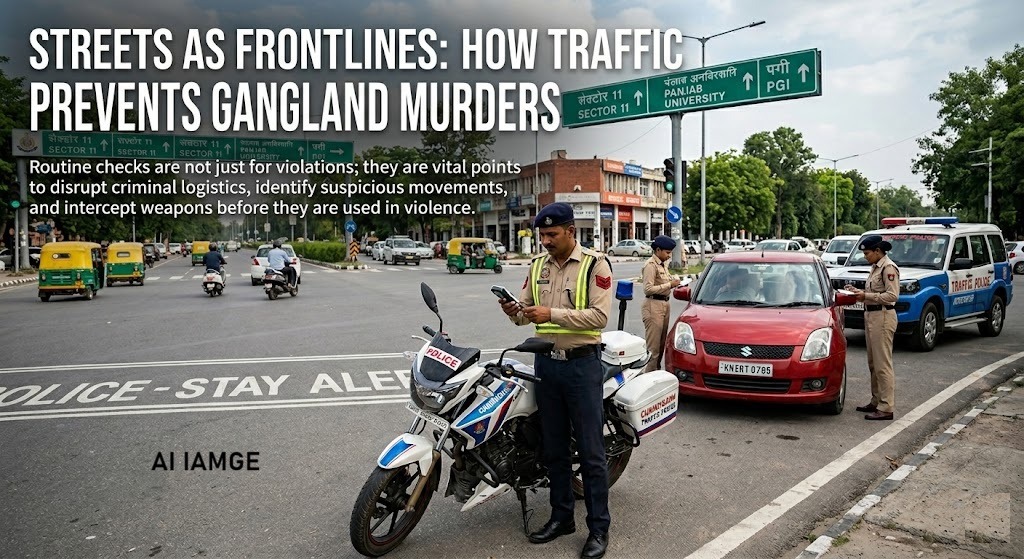
Traffic safety isn’t just about road rules; it’s a vital front line for preventing violent crime. When police ignore basic visual red flags like triple-riding, masked faces, and bent plates, they miss the chance to stop criminals before they pull the trigger.
Following the public outrage over the Sector 11 incident, the administration took a hard look at this lapse. In fact, five police personnel (including a sub-inspector) who were deployed at the nearby checkpoints were suspended for negligence.
Here is how that exact angle breaks down into a news editorial.
THE SECURITY LOOPHOLE: How Traffic Vigilance Can Prevent Gangland Murders
CHANDIGARH – The brutal, broad-daylight gunning down of a cashier at a Sector 11 chemist shop has exposed a glaring vulnerability in the City Beautiful’s law enforcement framework. While Chandigarh Police aggressively penalizes ordinary citizens for minor traffic infractions, three contract killers managed to traverse the city’s streets completely unhindered—despite triple-riding on a motorcycle, wearing medical masks, and riding with a intentionally bent license plate.
The tragedy raises a damning question: Where was the city’s famed traffic police, and why are visual red flags being treated as mere traffic violations rather than high-stakes security threats?
Missing the Red Flags
On the afternoon of the shooting, the three assailants did not slide through hidden alleys. They rode on main sectors, crossing critical junctures. To any alert law enforcement officer, their profile was a textbook security alert:
Triple Riding: A clear violation usually intercepted immediately.
Covered Faces: Masking features in broad daylight outside of a health crisis context.
Obscured License Plate: The bike’s plate was deliberately bent to evade CCTV tracking.
Had a single traffic cop or checkpoint (naka) team stopped the vehicle for simple traffic non-compliance, the entire murder plot would have collapsed. A routine search would have revealed the automatic 9mm pistols, saving a life and putting dangerous contract shooters behind bars before they ever reached their target.
When Traffic Rules Become Crime Prevention
Law enforcement agencies worldwide utilize a strategy known as the “Broken Windows” approach—the principle that enforcing minor laws creates an environment of order and deters major crimes. In Chandigarh, the reverse occurred. The shooters correctly gambled that they could coast past checkpoints because traffic enforcement is often viewed mechanically rather than preventatively.
Traffic police are the most visible, mobile, and distributed arm of the police department. They are not just there to issue revenue-generating tickets; they are the frontline eyes and ears of city security. When an officer ignores a triple-riding bike with masked passengers, they aren’t just letting a traffic violation slide—they are potentially letting a hit squad pass.
A Costly Lesson in Alertness
The top brass has recognized this failure. Following a surprise inspection by senior officials, five police personnel—including a sub-inspector stationed at the Sector 11 checkpoint—were suspended for operational negligence.
While the Crime Branch and J&K Police managed to arrest the shooters from a forest area in Jammu days later, the arrest is reactionary. True policing is proactive. The Sector 11 tragedy must serve as a permanent wake-up call. Chandigarh’s checkpoints cannot afford to be passive hurdles. Every bent license plate, every covered face, and every triple-rider must be treated as a potential threat. Because next time, stopping a bike for a missing helmet might just intercept a murderer.
